
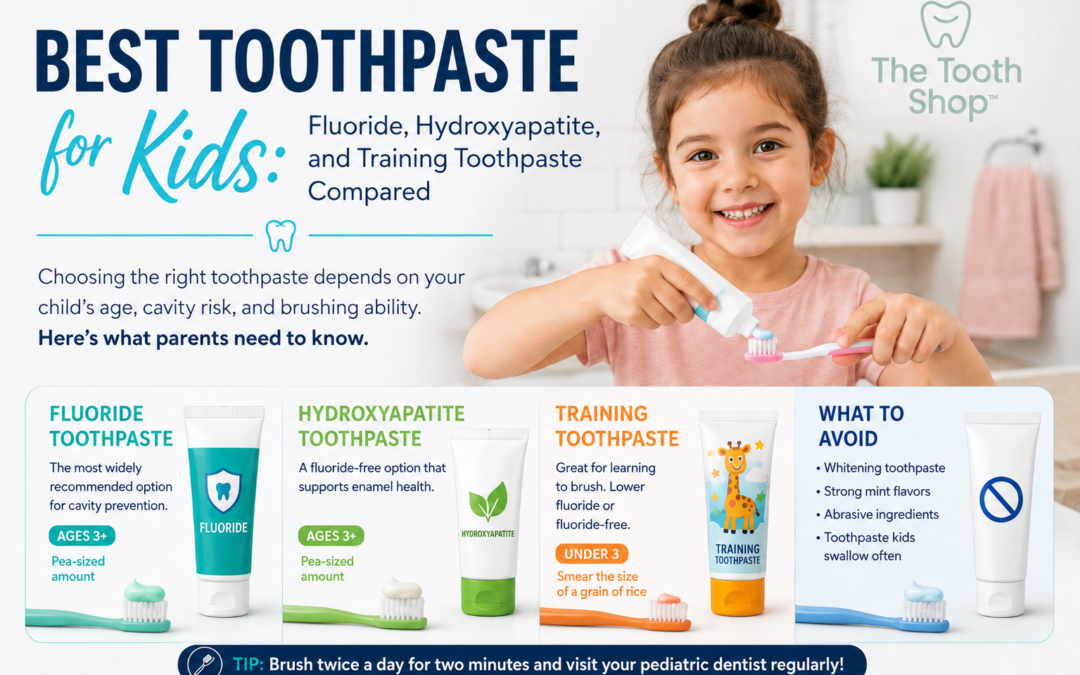
Best Toothpaste for Kids: Fluoride, Hydroxyapatite, and Training Toothpaste Compared
Choosing toothpaste for your child seems simple until you stand in the dental aisle and see dozens of options: fluoride toothpaste, fluoride-free toothpaste, hydroxyapatite toothpaste, training toothpaste, whitening toothpaste, natural toothpaste, character toothpaste, and more.
So which one is actually best for kids?
The answer depends on your child’s age, cavity risk, brushing habits, and whether they can spit reliably. The good news is that parents do not have to guess. A pediatric dentist can help you choose a toothpaste that supports your child’s teeth without overcomplicating your routine.
Best Overall Toothpaste for Most Kids: Fluoride Toothpaste
For most children, a fluoride toothpaste is still the standard recommendation for cavity prevention. The American Academy of Pediatric Dentistry encourages brushing with the appropriate amount of fluoride toothpaste twice daily for children.
Fluoride helps strengthen enamel and makes teeth more resistant to acid attacks from bacteria and sugars. That matters because children are still learning how to brush well, and baby teeth can develop cavities quickly.
The key is using the right amount.
For children under age 3, the American Academy of Pediatrics recommends a tiny smear of fluoride toothpaste, about the size of a grain of rice. For children age 3 and older, a pea-sized amount is recommended once they can spit more consistently.
Best for:
Kids with moderate to high cavity risk
Kids who snack frequently
Kids with grooves in their molars
Kids who have had cavities before
Families who want the most widely recommended cavity-prevention option
Best Fluoride-Free Alternative: Hydroxyapatite Toothpaste
Hydroxyapatite toothpaste has become a popular option for parents looking for a fluoride-free alternative. Hydroxyapatite is a mineral form related to the structure of enamel, and some toothpastes use it to support remineralization.
This can be a helpful option for families who prefer fluoride-free products, but it is still a good idea to talk with your child’s pediatric dentist before switching, especially if your child has had cavities or is at higher risk.
Best for:
Families looking for a fluoride-free option
Kids with low cavity risk
Parents who want to discuss alternatives with their pediatric dentist
Children who already have strong brushing and diet habits
Best for Babies and Toddlers: Age-Appropriate Toothpaste
For babies and toddlers, the most important thing is not the flavor, brand, or packaging. It is using an age-appropriate amount and brushing consistently.
Once the first tooth appears, parents can begin brushing with a soft toothbrush and a tiny smear of toothpaste. The AAP recommends starting fluoride toothpaste when the first tooth erupts, using a grain-of-rice-sized amount until age 3.
Best for:
Babies with new teeth
Toddlers learning to brush
Parents building a routine early
Children who swallow toothpaste instead of spitting
What About Training Toothpaste?
Training toothpaste is usually fluoride-free and designed for very young children who are learning to brush. It can help create a brushing routine, but it may not provide the same cavity-prevention benefits as fluoride toothpaste.
Training toothpaste may be fine as a short-term stepping stone, but parents should ask their pediatric dentist whether it is the best choice for their child’s cavity risk.
Best for:
Very young children learning the brushing routine
Kids who strongly resist brushing
Short-term use while transitioning to a dentist-recommended toothpaste
Toothpastes Parents Should Be Careful With
Some toothpastes are not ideal for younger kids.
Be cautious with:
Whitening toothpaste
Charcoal toothpaste
Strong mint flavors that burn or sting
Abrasive “natural” toothpastes
Adult toothpaste used in large amounts
Toothpaste children swallow frequently
Kids do not need whitening toothpaste. They need a toothpaste that helps prevent cavities and keeps brushing simple.
Quick Comparison: Which Toothpaste Is Best?
Toothpaste Type Best For Parent Note
Fluoride toothpaste Most kids Strong standard option for cavity prevention
Hydroxyapatite toothpaste Fluoride-free preference Ask your pediatric dentist, especially if your child has cavities
Training toothpaste Early brushing practice May not provide the same cavity protection
Whitening toothpaste Older teens, if appropriate Usually not needed for children
Charcoal toothpaste Generally avoid for kids Can be abrasive and unnecessary
The Tooth Shop Recommendation
The best toothpaste is the one that fits your child’s age, cavity risk, and brushing ability. For many kids, that means a fluoride toothpaste in the correct amount. For others, a fluoride-free alternative may be worth discussing.
At The Tooth Shop, we help parents choose simple, realistic oral health routines that work for real family life.
FAQs About Kids’ Toothpaste
What toothpaste should my toddler use?
Many pediatric dental and pediatric medical organizations recommend using a tiny smear of fluoride toothpaste once the first tooth appears. For toddlers under age 3, use an amount about the size of a grain of rice.
How much toothpaste should my child use?
Children under age 3 should use a tiny smear, about the size of a grain of rice. Children age 3 and older can usually use a pea-sized amount, especially once they can spit well.
Is fluoride toothpaste safe for kids?
Yes, fluoride toothpaste is widely recommended for children when used in age-appropriate amounts and with parent supervision. Parents should help young children brush and avoid letting them swallow large amounts of toothpaste.
Is hydroxyapatite toothpaste good for kids?
Hydroxyapatite toothpaste may be an option for some families, but it is best to ask your pediatric dentist whether it is appropriate for your child’s age and cavity risk.
When should my child switch from training toothpaste?
Ask your pediatric dentist, but many children can begin using an age-appropriate amount of fluoride toothpaste once teeth appear. Training toothpaste may be useful for building the habit, but cavity prevention should be part of the decision.
To learn more, reference our parent’s guide. We even have a free download!
https://www.toothshop-az.com/parent-resources/guides/fluoride-vs-hydroxyapatite/
Recent Comments