
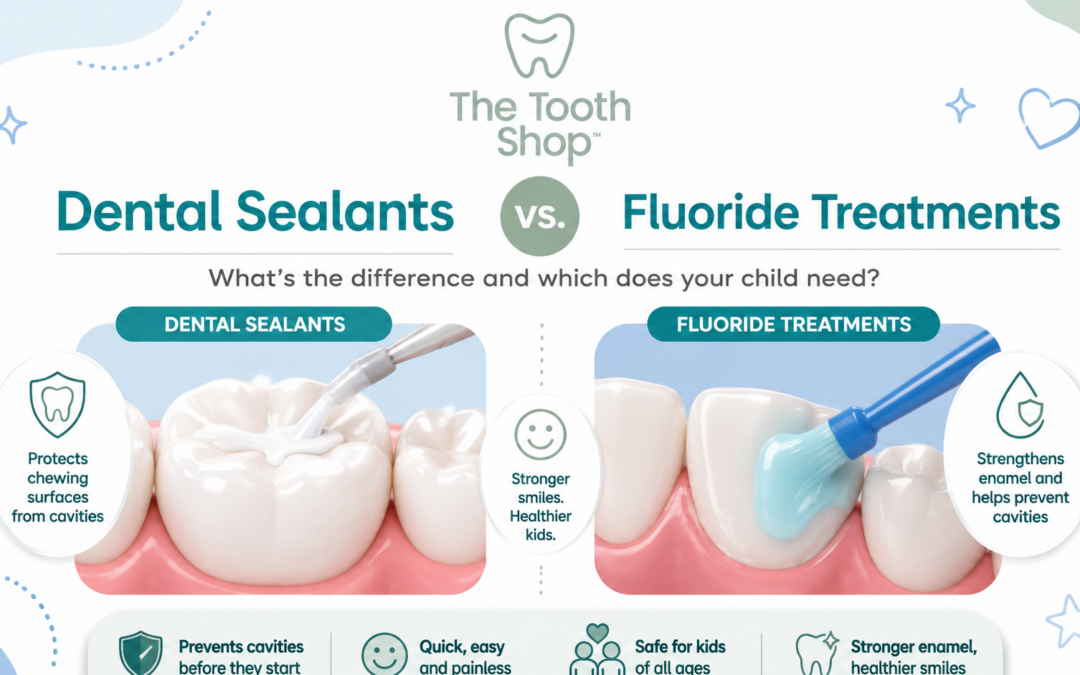
Dental Sealants vs. Fluoride Treatments: What’s the Difference and Which Does Your Child Need?
Parents often hear the words “sealants” and “fluoride” at dental visits, but it is not always clear what each one does.
Are they the same thing? Does your child need both? Is one better than the other?
The simple answer is that sealants and fluoride protect teeth in different ways. They are not competing treatments. For many children, they work best together.
What Is Fluoride?
Fluoride is a mineral that helps strengthen enamel and protect teeth against cavities. It can be found in toothpaste, drinking water in many communities, professional fluoride treatments, and some dental products.
Fluoride is especially helpful because it supports the tooth surface against acid attacks from bacteria and food. The AAP continues to recommend age-appropriate use of fluoride toothpaste and fluoridated water to protect children’s teeth.
What Is a Fluoride Treatment?
A fluoride treatment is a professional application placed on the teeth during a dental visit. It may come as a varnish, gel, foam, or rinse, depending on the office and the child’s needs.
A pediatric dentist may recommend fluoride treatments for children who:
- Have had cavities
- Are at higher risk for cavities
- Have deep grooves or hard-to-clean areas
- Snack frequently
- Wear braces or appliances
- Have dry mouth
- Need extra enamel support
What Are Dental Sealants?
Dental sealants are thin protective coatings placed on the chewing surfaces of back teeth, especially molars. These teeth often have deep grooves where food and bacteria can get stuck.
Sealants help cover those grooves so they are easier to keep clean. The American Dental Association notes that sealants are effective in preventing and arresting pit-and-fissure cavities in primary and permanent molars in children and adolescents compared with no sealants or fluoride varnishes alone.
Sealants vs. Fluoride: The Main Difference
Think of fluoride as strengthening the tooth surface, while sealants act like a protective shield over the grooves of back teeth.
| Feature | Fluoride | Sealants |
| What it does | Strengthens enamel | Covers grooves in back teeth |
| Best for | Overall cavity prevention | Molars with pits and grooves |
| Where it works | All tooth surfaces | Chewing surfaces of molars |
| How it is applied | Brushed or painted on | Bonded to the tooth surface |
| Best timing | Throughout childhood | Often when molars come in |
Which One Is Better?
Neither is “better” in every case. They do different jobs.
Fluoride helps protect the enamel across the mouth. Sealants help protect the chewing surfaces of back teeth, where grooves can trap food.
For many kids, the better question is not “sealants or fluoride?” It is “Does my child need both?”
When Does a Child Need Sealants?
A child may benefit from sealants when permanent molars come in, often around ages 6 and 12. Some children may also benefit from sealants on baby molars if they are at higher cavity risk or have deep grooves.
Sealants are especially helpful for kids who:
- Have deep grooves in molars
- Have a history of cavities
- Struggle to brush back teeth well
- Eat frequent snacks
- Have enamel concerns
- Wear orthodontic appliances
When Does a Child Need Fluoride?
Fluoride may be recommended as part of routine cavity prevention, especially if a child has higher cavity risk. A pediatric dentist may consider brushing habits, diet, cavity history, water fluoride exposure, enamel strength, and dental development.
Can Sealants Prevent Every Cavity?
No. Sealants protect specific surfaces, mostly the grooves of molars. They do not protect between teeth, along the gumline, or every area where cavities can form.
Children still need:
- Brushing twice a day
- Flossing once teeth touch
- Regular dental cleanings
- Smart snack habits
- Fluoride as recommended
- Dental checkups to monitor sealants
How The Tooth Shop Helps Parents Decide
At The Tooth Shop, we do not recommend treatments just because they exist. We look at your child’s teeth, age, cavity risk, brushing ability, diet, and dental history. Then we explain which preventive options make sense and why.
The goal is simple: help your child avoid cavities with the least stressful, most practical plan possible.
FAQs About Sealants and Fluoride
Are sealants better than fluoride?
Sealants and fluoride do different things. Sealants protect grooves in back teeth. Fluoride strengthens enamel more broadly. Many children benefit from both.
Does my child need sealants if they use fluoride toothpaste?
Possibly. Fluoride toothpaste helps strengthen enamel, but it may not fully protect deep grooves in molars where toothbrush bristles cannot clean as easily.
How long do dental sealants last?
Sealants can last for years, but they need to be checked at regular dental visits. If a sealant wears down or chips, the dentist may repair or replace it.
Are fluoride treatments necessary for kids?
Not every child needs the same fluoride schedule. A pediatric dentist can recommend fluoride based on your child’s cavity risk, age, brushing habits, and dental history.
Can sealants be placed on baby teeth?
Yes, in some cases. If baby molars have deep grooves or a child is at higher risk for cavities, a pediatric dentist may recommend sealants on baby teeth.
Do sealants hurt?
No. Sealants are non-invasive. The tooth is cleaned, prepared, and coated. There is no drilling or numbing for a standard sealant.
To learn more about sealants and fluoride treatments, check out our Parent’s Guides and accompanying downloads.
https://www.toothshop-az.com/parent-resources/guides/dental-sealants-for-kids/
https://www.toothshop-az.com/parent-resources/guides/fluoride-vs-hydroxyapatite/
Recent Comments